
Modern Heirlooms
- Amanda Lennon

- Apr 4
- 4 min read
There’s a quiet shift happening in our homes. Less “buy cheap and replace it later,” and more “choose it once and love it always.” The pieces we’re drawn to now aren’t just beautiful – they’re useful, good quality and full of character. The sort of things that earn their place and become part of the home rather than just another possession.
That’s the essence of a modern heirloom: something chosen today, used daily, and still worthy of passing on tomorrow. Not something precious locked in a cabinet, but useful in daily life – a desk where ideas begin, a chair that’s sat in at the end of a long, a plate that’s hung, moved, and rehung as the mood and decor shifts.
At Chaos Cottage, we tend to favour the pieces that do both jobs – practical and beautiful – because those are the ones that stay.
Our Favourite Modern Heirlooms
The desk (or, why a bureau might be even better)
Despite the fact that I often work from the kitchen or dining table, I believe firmly that a good desk should feel like an invitation. Not a corporate afterthought, but somewhere you want to sit – to write, to plan and doodle, to read, or simply pause with a cup of tea and a notebook or a "to do" list.
Antique desks have a weight to them (literally and figuratively) that modern pieces often lack, but they can sometimes demand more space than we’d like to give.
Which is where the humble, yet often very stylish, bureau quietly comes into its own.


They are often pretty and compact but can be more utilitarian depending on the decade and style you opt for. They always come with fabulously fitted interiors useful for all sorts of bits and pieces. Our customers have used them in some surprising ways too - for underwear and make-up in place of and more useful than a dressing table.
With their fold-down fronts, hidden compartments and satisfyingly orderly interiors, bureaus offer structure without feeling imposing. They close away the day’s chaos (quite literally), turning paperwork into a clean surface in seconds. In smaller homes – or multi-purpose rooms – they’re a particularly kind solution.
And perhaps most importantly, they age beautifully. Scratches become part of the story; patina becomes part of the charm. This is furniture designed to be used, not tiptoed around and when it comes to affordability, they won't let you down.
The chair (the one everyone gravitates towards)
Every home has one. The chair that’s always chosen first. The one pulled closer to the fire, angled towards the light, quietly claimed without discussion. A well-made antique chair has a way of earning that role over time.


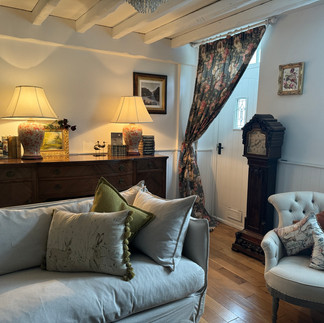


Whether it’s a simple kitchen chair with decades of wear or a more decorative occasional piece, or even a child's chair originally made by hand with love by a parent, these are the items that bridge usefulness and sentiment. They’re not just looked at – they’re lived with, loved and passed on.
Unlike so many modern equivalents, they’re built to be repaired, reupholstered, and reinvented. A new fabric, a small repair, and they begin another chapter.
Decorative plates (small things, big stories)
You may or may not be aware that I'm rather partial to china, particularly decorative plates and dinner services.... we have A LOT. I do appreciate that many of you will think they are the stuff of old ladies and stuffy cottages but trust me, they're far more than that. Yes, 'cottagecore' through and through but they have personality and some are particularly sought after.
Not everything needs to be large to be lasting.
Decorative plates sit somewhere between art and object – modest in scale, but surprisingly powerful in a room. Hung in a cluster, layered onto shelves, or simply propped on a sideboard, they add pattern, texture and a sense of quiet collecting.


They’re also wonderfully flexible. Collections can grow slowly, piece by piece, each one chosen for a reason (or sometimes no reason at all, beyond “I loved it”). In a world of mass production, they bring individuality back into a space – and that’s often what turns a house into a home.
The stool (the quiet workhorse)
If there’s an unsung hero of the home, it’s the stool.
Pulled into service wherever it’s needed – a perch in the kitchen, a plant stand by the window, a makeshift bedside table – it’s the kind of piece that earns its keep without fuss.
Old stools, in particular, have a simplicity that’s hard to replicate. Solid, honest, and endlessly adaptable, they move through a home with ease. Today a seat, tomorrow a surface, next week something else entirely.


They may not be the headline act, but they’re often the pieces we’d miss most.
For us, the most popular are small Victorian footstools - easily popped under the sofa or hidden away when not needed but often pretty with handmade tapestry tops.
Choosing pieces that last
Modern heirlooms aren’t about perfection – they’re about permanence.
They’re the things we reach for every day without thinking, the pieces that quietly support how we live, and the ones that feel better with age rather than worse.
Increasingly, people are choosing fewer, better-made items designed to last and be repaired – a shift away from the fast, almost disposable, furniture we (and the planet) have endured for a while now. We're turning towards something more considered and enduring.
A desk (or bureau) that gives your thoughts a place to land.
A chair you reach for at the end of the day.
Plates that shift and grow with your home.
A stool that’s always where you need it.
Because in the end, the pieces that stay are rarely the ones we bought in a rush – they’re the ones that quietly became part of the story.
Explore the collection and see if there’s a piece ready to become part of your story


Comments